
“Let me tell you a story of a dinosaur, who lived long ago, along an ancient shore. Then one day, he up and passed away, got washed into the water, and was buried in some clay,” paleontologist Michael Fix sings.

• Sydney Jones
Michael is hunched over a lab table singing the song he wrote to the tune of The Beverly Hillbillies theme song. With magnifying goggles strapped around his head, he starts assembling his tools that look like a comb with a sharpened end, tooth flosser, old paintbrush, and plastic spoon.
With his bare hands, he begins to use each tool to gradually remove the dry clay attached to a gray object. The room, with three walls out of four made of glass, gets thick with dust and fills with the sound of gentle scraping. Michael is relaxed but completely absorbed in his task.
To an untrained eye, he looks to be holding an oddly shaped rock. But as Michael continues to hum his song and flick tiny clay chunks into a black plastic bowl, the true identity of the gray object is revealed: a dinosaur bone. More specifically, a bone from the Missouri state dinosaur. Only found in Missouri, this species of dinosaur has a rich history that includes many twists and turns, including its purely coincidental discovery and ongoing series of reclassifications.
Subscribe
Get a Missouri Life Magazine Subscription & Save Up to 69% Off Newsstand Prices!
Subscribe Today
How was the dino discovered?
When Dan R. Stewart saw a curious young boy peek over a valley creek bank in Bollinger County in 1942, he didn’t know it would lead to a discovery that would alter Missouri’s history.

Dan was a Missouri Geologic Survey geologist from Rolla. He was exploring clay deposits in a watershed of Crooked Creek. The clay deposits were known to be part of the Cretaceous period, which was nearly 80 million years ago. As Dan searched, a young boy named Ole Chronister approached him and asked what he was doing.
After Ole heard about Dan’s clay pursuits, Ole invited him to look at a similar type of clay on his parent’s property in Glen Allen. When Dan arrived, Lula Chronister, Ole’s mother, called his attention to the unique bones she had discovered after digging her eight-foot well. The bones were found “embedded in a black plastic clay,” according to a 1945 article written by Dan and Charles W. Gilmore and published in the Journal of Paleontology.
Dan took some of the bones back to Rolla and had them examined by Henry A. “Chief” Buehler, the state geologist at the time. Henry simply remarked, “Why, those are only old cow bones.” But Dan wasn’t convinced and had one bone looked over by another expert: Charles Gilmore at the US National Museum in Washington, DC.
Charles confirmed it to be an elusive dinosaur bone. Dan had succeeded in what many people may only dream about doing: He had found the bone of a beast older than humanity.
• Michael Fix
After Charles confirmed the bone was a dinosaur vertebra, Dan sent Charles the remaining bones found on Lula’s property—aside from one that she had given to a relative.
The bones consisted of 13 caudal (tail) vertebrae and Dan Stewart Bruce Stinchcomb two other bone fragments. The 14th vertebra given to Lula’s relative was never seen again.
Despite the fact that this was the first time dinosaur bones were found in Missouri, Lula was awarded only $50 for the bones, which she used to purchase a cow.
What is this thing?
It was determined that the dinosaur was a plant-eating sauropod (think of the Longnecks in The Land Before Time). Sauropoda were known to be part of the Jurassic period, which was about 175 million years ago, yet Dan and Charles assumed this dinosaur was still part of the upper Cretaceous period, like the surrounding clay deposits it was found within. After some discussion, it was settled that it would be named Parrosaurus missouriensis.
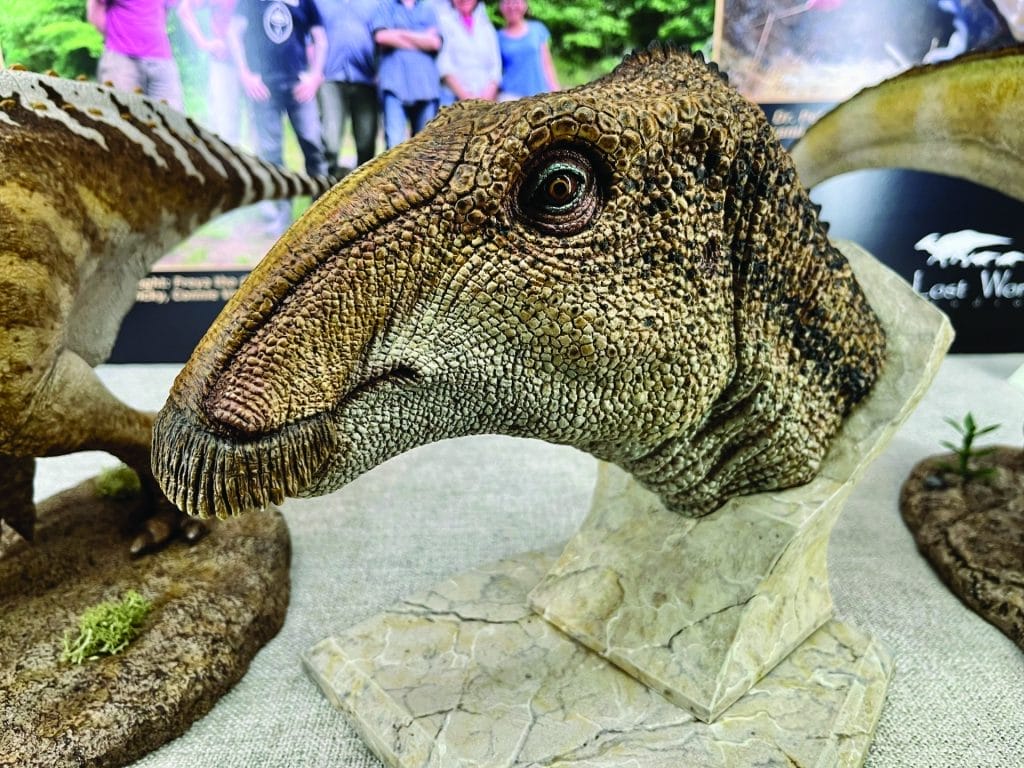
Further research in the 1970s found that the two bone fragments found alongside the vertebrae were skull bones. These fragments helped determine that the dinosaur was a hadrosaur, or a duck-billed dinosaur, which has more than 1,000 teeth. This type of dinosaur is known to stand on two legs to reach vegetation while also being able to walk on all fours. Therefore, this predominantly herbivorous dinosaur that was found in Missouri, whose species lived about 70 million years ago, was renamed from Parrosaurus missouriensis to Hypsibema missouriense. Yet, there was still more to be discovered about this mysterious dinosaur.

After years of no progress on the site where the bones were found on Lula’s property, Bruce Stinchcomb, a Missouri paleontologist and geology professor for Florissant Valley Community College, purchased the site in the 1970s from her son, Ole Chronister. Bruce, in conjunction with a team from the New Jersey State Museum, found an additional 31 fossils at the site, including four more Hypsibema missouriense caudal vertebrae.

Two team members who aided Bruce on the site were the up-and-coming paleontologists Guy Darrough and Michael Fix.
As a young teen, Guy met Bruce at a rock and mineral show and then “traveled everywhere” with him learning about fossils alongside him. “I was never home for Christmas. I was somewhere with Bruce digging,” Guy explains. “Fossils took priority over everything for me.”
Bruce’s former student, Michael, also grew to have a passion for paleontology under his tutelage.
“Bruce is one of these people who if you showed an interest, he would work very hard to encourage that interest and mentor you,” Michael says. “He took me on fossil collecting trips, and he gave me fossils. I got bit by the fossil bug, thanks to Bruce.”
Bruce’s mentees then became the masters. Guy and Michael began to excavate the Chronister site in 1990.
Who is this Guy?
Instead of poring through books in college, Guy Darrough spent his young adult years with one hand gripping the wheel of his 1967 Volkswagen bus and the other resting on his German shepherd. He was from north St. Louis and a self-described hippie that never finished high school. This was juxtaposed with his lifelong love for science and fossils. With a long ponytail, he would travel across Missouri and other states in search of roadcuts and outcrops that contained fossils.

He would keep his favorite fossils and sell the rest to museums or geological companies. Guy used the profit to fund his adventures to hunt for more fossils.
“I remember a teacher telling my dad, ‘This kid just doesn’t pay attention. He’s not going to make it.’ ” Guy explains. “And then I ended up finding all these discoveries.”
The more he learned about fossils as a young entrepreneur, the more connected he got with people in the paleontology community, including Bruce Stinchcomb.
“I got in with a lot of paleontologists and scientists that took a liking to me because whenever I found something valuable, I would give it to them,” Guy says. “Because if it’s something new, I wanted to be recognized. I didn’t sell them. So because I did that, they allowed me to go with them all over and learn right on the spot. I was just watching them, and they were teaching me. I didn’t even know they were. I was just picking up on stuff.”
As time went on, instead of giving away his fossils, Guy began stockpiling them in hopes of having a museum someday. “I would say—this was just ridiculous but—‘I want to find one of every geological period in each formation.’ And I set out to do it.” Yet as a self-made man, he needed a new way of earning income and more ways to build relationships with other fossil lovers.
To fill this need, he began creating, then renting out life-sized dinosaur models to botanical gardens. Ancient, menacing eyes and jaws full of blade-like teeth towered over him in his studio.
As his new business, Lost World Studios, grew, the gates to the world of paleontology opened wider.
How did it become the state dino?
Guy and Michael worked together side by side at the Chronister site for almost 20 years. Michael was known to be meticulous and patient and Guy was eager and expeditious—together a perfect recipe for a paleontological partnership.
“We wanted to do everything as precisely as possible because we weren’t professionally published paleontologists, and we knew that people were going to be really scrutinizing what we were doing,” Michael says. “Turns out, our mapping was much more precise than what is typically done.”
From 1990 to 2009, they found about 170 fossils and dinosaur bone pieces, including a partial skeleton of an approximately 20-foot long juvenile Hypsibema missouriense; a tooth from a tyrannosaurid, a relative of the T. rex; and a tooth from a raptor. Altogether, the juvenile skeleton, its plaster jacket (a man-made plaster casing that protects the bones and surrounding clay), and the pallet that it was all placed upon weighed about 900 pounds.
“When you see a fossil, there is a kind of sense of exhilaration because you are the first person to ever see that. So it has something in common with treasure hunting, where you suddenly uncover something special,” Michael says.

Guy made a similar comparison saying, “It’s like finding King Tut tomb in Missouri. There’s nothing close to it.”
During the years of backbreaking work of finding and excavating the juvenile bones, Guy decided that it was time to make it official. Guy helped get legislation introduced to make Hypsibema missouriense the Missouri state dinosaur.
With overwhelming bipartisan support, in 2004, the state dinosaur made its debut.
“It was all kind of an official, kind of a scary thing, but they asked me to tell my little episode, and I did,” Guy says. “It must have worked out because it’s the official state dinosaur. It’s really our official state dinosaur because it has to be. There’s nothing else. I mean, it just has to be.”

What now?
In 2016, Guy invited Peter Makovicky, a professor of earth and environmental sciences at the University of Minnesota, and a team from the Field Museum in Chicago, Illinois, to take over the dig at the Chronister site.
“I said, ‘Pete, you got to come on down.’ And he comes down. He goes, ‘Wow, you guys got dinosaurs in Missouri?’ And I said, ‘Yeah, they’re only a few hours from Chicago, so you don’t got to drive out west. It’s miraculous,’ ” Guy says.
Guy is still the director of the Chronister site; however, the site is now owned by the nonprofit Missouri Ozark Dinosaur Project.

“Guy has been a fantastic and tireless collaborator from the get-go,” Peter says. “Simply put, he is the main motivator behind the project and has a real passion for the discoveries at the site.”
Peter and his team have collected over 150 fossils and Missouri dinosaur bones—at least four different duck-billed dinosaur skeletons, about a dozen complete or nearly complete turtle shells, and two fish skeletons.
More specifically, they discovered bones from both a museum from Guy’s private collection. The artifacts 30- and 40-foot long adult Hypsibema missouriense. The 40-foot dinosaur is often referred to as “The Beast.”
If the sheer length of these dinosaurs doesn’t seem impressive, their thumbs just might be.
They found four-inch thumb spikes on the 30-foot skeleton and an eight-inch thumb spike with the 40-foot skeleton.
These spikes are a known characteristic of an iguanodon, and it is thought that they were used as a form of defense. This means the Hypsibema missouriense actually is a mixture of both a hadrosaur and an iguanodon, also known as a plant-eating hadrosaurid.

The dinosaur bones from the Chronister site are the only remains of this species ever found, according to Michael.
“Now, because of that bone [the thumb spike], it [the Hypsibema missouriense] has been reclassified, but this happens in paleontology all the time because you very seldom find all the bones all at once,” Michael says. “They show that in movies all the time, but that is rare. Most dinosaur species are based on very fragmental remains and very incomplete skeletons.”
Because of the new discoveries, the age of the Hypsibema missouriense is now estimated to be 95 million years old.
Following this, the dinosaur was renamed yet again, reverting back to Parrosaurus missouriensis—its originally coined name from the 1940s. The site is still being excavated, so who knows what the name of the Missouri state dinosaur might evolve into one day?
Where can I see the dino?
In the almost all glass room at the Ste. Genevieve Museum Learning Center, Michael points at paper labels that mark bones, peeking out from the clay. A shoulder here. A vertebra there. Some bones are more exposed than others. Some bones are in shattered pieces.

Michael volunteers at the museum, letting visitors watch him excavate real juvenile bones from the Parrosaurus missouriensis.
Guy is the curator of the museum, which has made it its mission to honor the Missouri state dinosaur through a unique experience: a gallery dedicated to information about the dinosaur and lifelike models of the dinosaur made by Guy’s Lost World Studios.
Other Missouri state dinosaur bones are being studied at the Field Museum in Chicago and the Smithsonian National Museum of Natural History in Washington, DC.
Besides Missouri state dinosaur memorabilia, the Ste. Genevieve Museum Learning Center also has a “Hall of Giants” area that has eight life-size floor-to-ceiling Lost World Studio models of other dinosaurs, such as the T-rex.
In addition, the museum has thousands of ancient artifacts and fossils, most of which are loaned to the museum from Guy’s private collection, The artifacts include everything from Viking tools to a Mayan mask to Native American jewelry.
The museum also hosts fossils like the crinoid, which is the Missouri state fossil. A goal of the museum is to engage children, so many of the exhibits have replicas that visitors can touch and play with.
Guy has flooded the museum with found items from across the world, and he highlights the story of the Missouri state dinosaur and how a curious boy led to the discovery of a lifetime. “There is no discovery that you could mention to me that’s more rare and more important than the Missouri dinosaur,” Guy says.

The Ste. Genevieve Museum Learning Center, which displays bones from the Missouri state dinosaur, is open from 10 AM–5 PM, seven days a week.
This article was originally published in the June 2025 edition of Missouri Life magazine.


