
Throughout the early 19th and 20th centuries, mills were an essential part of Missouri’s economy and landscape, providing cornmeal, flour, precut wood, and even fabric to families. From textile mills in the north to gristmills in the south, mills brought communities together. Today, many of Missouri’s historic mills still stand, preserving stories of ingenuity and enterprise. Explore several mills open to the public, each with a unique story to tell.
Alley Mill
A Vertical Wheel Flour Mill
Tucked away in the Ozarks near Eminence is Alley Mill. This mill is listed on the National Register of Historic Places and is a beloved reminder of the area’s history and beauty. Its rugged red exterior stands in sharp contrast to the turquoise spring water that once powered its turbine belts. Alley Mill shoots out an astounding 300 million gallons of water into Jack’s Fork River each day. William Barksdale and John Daugherty built the original mill on the site in 1870, but it was soon destroyed by a fire. Then, in the 1890s, George Washington McCaskill built the mill that can be seen today. Powered by a wooden vertical water wheel, this custom-built mill would grind wheat into flour for local farmers for a toll, or a percentage of their product. Unfortunately, the mill’s success was hampered as it was built specifically for flour, while corn was the more popular crop in the region. The mill ceased operating in 1918 and is now open for free self-guided tours. Visitors can walk around the mill, see the milling equipment, and learn the history of Ozark milling.
On a self-guided tour, visitors learn that the mill operated with the power of a 35-inch Leffel Co. turbine located beneath the back porch of the mill. The control wheel on the porch regulated the water flow to the turbine that powered the machinery. This technique was more efficient than most wheels of the time. In the basement of the mill, a drive shaft ran the length of the building to transfer power to elevators and belts. Then, on the first floor, which is open to the public, grain was stored in bins, fed into milling machines, ground repeatedly, and elevated upstairs where large sifters refined the flour to its desired fineness. With forested hiking trails, including an overlook that offers views of the mill and bluffs, this is an idyllic spot for nature lovers.
Subscribe
Get a Missouri Life Magazine Subscription & Save Up to 69% Off Newsstand Prices!
Subscribe Today


The Mill at Dogwood Canyon
A Vertical Wheel Corn Gristmill
Dogwood Canyon in Lampe is a picturesque nature preserve offering fishing excursions, biking, hiking, horseback riding, scenic trails, a million-dollar treehouse, nature programs, Amish-built covered bridges, chapels, and a tram tour from which wildlife can be spotted. The property is a cozy and inviting space—a scenic respite in the heart of the Ozarks.
However, the most recognizable attraction at Dogwood Canyon is the beautiful water wheel that welcomes visitors to the site. Modeled after early 1900s Ozark mills, Dogwood Mill tells the story of Ozark milling and its impact on the local economy.
Head miller C. B. Adams guides visitors through “her”—as mills are affectionately called. Most mills in the Ozarks used large visible exterior water wheels to harness the power of flowing water from a river or spring. As river flow often fluctuates with the weather, these mills were less efficient than turbine mills and required frequent maintenance. By the late 1800s, many mills transitioned to enclosed metal turbines, which provided greater power and efficiency while remaining hidden beneath the mill’s structure. At set grinding times—every day at 10 am, 12 pm, and 2:30 pm, visitors can watch corn become fresh-ground cornmeal and then purchase packages of it in the gift shop. This mill uses a vertical wheel to produce approximately 4,500 pounds of cornmeal a year.
The four-story operation is impressively clean, regularly inspected, and regulated for the safety of workers and the final product. The two millstones, measuring 36 inches in diameter and weighing nearly 1,400 pounds for the pair, are the centerpieces of the operation. In larger mills such as Dogwood Mill, stones this size are called “pony stones.” The bottom stone, known as the “bed stone,” is stationary while the top stone, usually called the “runner stone,” rotates. The gap between the stones is adjusted to determine the size or fineness of the grind. While visitors tour only the first floor, they can look up and view the rest of the mill. The second floor is where the grain is cleaned, sifted, and bagged, and the third is for storage. This open floor concept allows visitors to see the process firsthand on a self-guided tour of the first floor, as bags of corn are carried upstairs by a bucket elevator to the Clipper cleaner (a machine that cleans the grain). From there, the cleaned grain is sent down a chute into a wooden funnel called a hopper that feeds grain into the millstones. This begins the milling process.
A clutch system is used to control the speed of the water coming in from the 25-foot water wheel, the tallest in the Ozarks. The wheel runs as fast as seven revolutions per minute. The miller closely monitors humidity, which has major effects on milling performance and belt tension.
“You run a mill like an alarm clock. You should be able to fall asleep on a pile of corn and know if something has gone wrong,” C. B. says. “A common hyperbole in the industry is that a good miller knows the exact sound of his mill so well that he could fall asleep, and even the slightest change in the sound of the machinery would wake him up. Sound is one of the biggest tools a miller can use.”
On grinding days, visitors can watch C. B. in action since he mills all day long. You can hear his enthusiasm for mills as he bestows information. “Man’s ability to recreate a soul has occurred twice in history—once in the gristmill and once in the steam train. Nothing has a mind of its own quite like a gristmill or a steam engine. You can build a hundred of them, and each one will have something unique that cannot be replicated.”

Dillard Mill State Historic Site
A Turbine-Powered Roller Mill
One of Missouri’s best preserved water-powered mills is the bright red two-story Dillard Mill in Crawford County overlooking the confluence of the Huzzah and Indian Creeks. The current mill is built on the original site of Wisdom’s Mill, which was built in the 1850s. Throughout the 1800s, the community grew and adopted the name Dillard in honor of the new mill owners, Joseph Dillard Cottrell and his brother James. The original mill was destroyed in 1890, and Polish immigrant siblings Emil and Marie Mischke bought the land and built a new mill from 1904–1908 using salvaged timber and modern technology for the time, including steel rollers and a 24-inch Leffel Co. underwater turbine to power it.
The mill became a hub of the community with local farmers bringing grain to be ground for a payment of one-eighth of the grain for the miller. Marie partnered with her brother Emil in the business until 1917, when he became the sole proprietor. Tired of bachelorhood, Emil sent for a mail-order bride from California but soon found that his new wife did not care for the Ozarks. They sold the mill to Lester Klemme in 1930 and moved to California that same year. Lester was an entrepreneur who expanded the property by building Klemme’s Old Mill Lodge and offering lodging, meals, fishing, and outdoor recreation for $7 a day. Lester continued to operate the mill until 1956, and the lodge remained active through the 1960s.
Tour guide Cindy Carmack shared her favorite story from the mill’s history—Lester Klemme’s homemade diving helmet. During tours, she enjoys showing visitors the unusual invention on display. According to Cindy, “The dam for the mill had been poured over a root wad, which eventually created a hole in the structure. Lester needed a way to dive 20 feet underwater to make repairs. So, he built a custom diving helmet out of a lard can. He turned the can upside down, added a funnel, a piece of glass for a viewing window, and a hose to supply oxygen. Rubber was added around the rim to create a seal, and weights were attached to keep it from floating. He took it to a local machine shop to help assemble and seal the helmet.” Lester then hired a local man named Goose Turnbough to wear the helmet and dive down to fix the hole, while air was being pumped by bellows through the hose. Remarkably, the contraption worked. Today, guests still enjoy hearing the tale and seeing the helmet on guided tours.
In 1974, the L-A-D Foundation purchased the mill and partnered with the Missouri Department of Natural Resources to preserve the site. It is now operated by Missouri State Parks, and visitors can take tours year-round to learn more about the mill. The park also offers scenic hiking trails, wildlife viewing, and picnic areas perfect for enjoying the beauty of the Ozarks.
Making Sense of Mills
Gristmill: In their early days, these mills were often in close proximity to a river with a consistently moving current, as they were typically powered by water. A water wheel on the outside of the mill harnessed the energy from the moving water, causing two grinding stones to turn in opposite directions, grinding the grain. Products from a gristmill include cornmeal and flour.
Roller Mill: Roller mills powered by turbines became popular in the late 1800s as a more efficient alternative to traditional stone grinding. Grain passes between pairs of rollers, with one roller spinning faster than the other to shear and crush the kernels. This produces finer, more uniform flour and livestock feed.
Sawmill: Sawmills were often run by steam or water—depending on the size of the mill and its operations. In Missouri, the circular saw was popular. This saw has a circular blade that rotates with the help of an attached axle. Powered from either a water wheel or turbine (a rotary engine that uses fluids such as steam or water to generate power), the axle is turned, allowing the saw blade to continuously run. Sawmills today still produce graded lumber for construction.
Textile Mill: In early textile mills, water or steam were used to power the machines. Several different machines work in these mills to process, clean, separate, spin, and weave textiles such as wool or cotton. The fibers are then transformed into goods like fabric, blankets, or yarn.


• Kristina Light

The Ozark Mill at Finley Farms
A Turbine-Powered Gristmill
Finley Farms, located in Ozark just outside of Springfield, is a flourishing home to multiple restaurants, a coffee shop, semi-covered bridges, an open-air chapel, and a small sustainable working farm. There is also a workshop and fills its buckets.gardening, culinary arts, and mixology. However, the site’s centerpiece is the beautifully rebuilt and restored gristmill: The Ozark Mill.
Originally opened in 1833, The Ozark Mill—one of the earliest gristmills in the region—connected the community to the Finley River. After its closing, the mill remained dormant for 32 years until it was reopened to the public in September 2021 as a working mill, museum, restaurant, farm, and event space.
In 1993, Johnny Morris, founder of Bass Pro Shops, purchased the property, and his team of craftsmen worked to rebuild and restore the mill on the foundation of the original structure. During the restoration, the 400-ton mill was moved about 50 yards away to allow the foundation to be rebuilt, then was returned to its original location using a track system. At the mill, tours are available to visitors where they can view the footage of the remarkable restoration process.
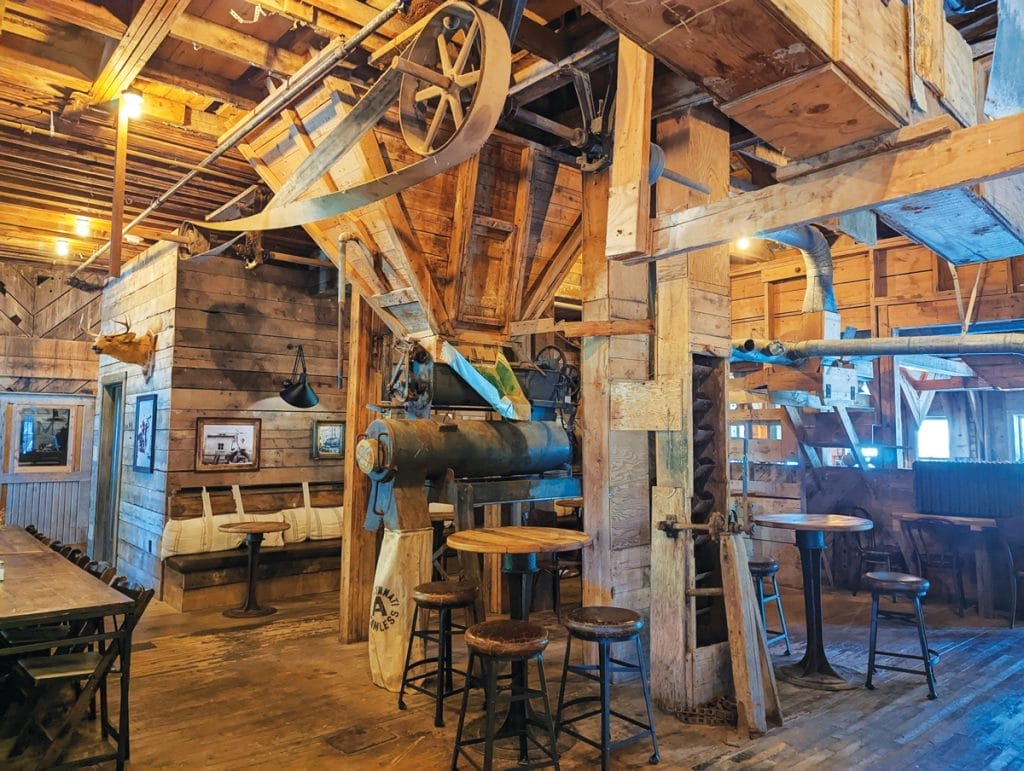
C. B. Adams, head miller for both The Ozark Mill and Dogwood Canyon’s mill, which is also owned by Johnny Morris, gives in-depth tours at both sites. Unlike many mills in the region, The Ozark Mill is turbine operated, meaning it converts the energy from flowing water into mechanical energy that keeps the mill running. C. B. explains, “They built the dam with fairly low head pressure, which flows into the penstock, where bars prevent debris from entering. Water pressure spins the turbine blades and powers the mill. The water flow, the speed, the functioning, and the balancing of a turbine are so complex that they were typically manufactured rather than hand-built. James Leffel & Co. built this one—the same company that supplied turbines for Niagara Falls.” In 1900, it took approximately five people per day to operate the mill. Production increased over time as new efficiencies were introduced.
The mill, originally known as Hoover’s Mill, is a key reason the community of Ozark grew. At one time, the mill served as the hub of the community, doubling as a post office, gathering place, and polling place. The town was also called Hoover’s Mill until 1840, when the Ozark name began to be used.
As Missouri’s last commercial mill, in operation until 1992, the preservation of this site and its transformation into a museum allow for a unique look into the state’s history. The self-guided, ADA-accessible tour is an immersive experience that starts with silhouettes of mill workers and locals projected next to the still-functioning machinery, bringing the story of the Ozarks to life.
The tour gives visitors a behind-the-scenes look at the equipment, the miller’s catwalks, and the technology and how it all works. Visitors also learn about the lives of mill workers outside of their milling job. One of the most famous mill workers was Byron “By” Kelley, an African-American bass fiddler who became a beloved musician in the Ozarks, performing at Silver Dollar City and the Ozark Opry.


• Kristina Light

• Kristina Light

Watkins Woolen Mill
A Steam-Powered Textile Mill
Waltus Watkins moved from Kentucky to Missouri in the early 1800s. He and his wife first settled in Liberty before buying 80 acres near Lawson in 1839. Over time, he expanded his holdings to 3,660 acres of land, creating a thriving farm and woolen mill.
Today, Watkins Woolen Mill State Historic Site and Park has spaces to camp, hike, swim, kayak, fish, and bike. But the true highlight of the park is the historic site that preserves Watkins’s legacy as an entrepreneur and innovator.
Tours begin at the visitor center, where a film and interactive exhibits explain the impact of the Industrial Revolution on millwork and relay the Watkins family story. Guided tours of the home and mill follow, each about an hour long.
The antebellum home offers a glimpse into 19th-century life in western Missouri. It includes a parlor, kitchen, bedrooms, and several outbuildings, such as a barn and icehouse.
The main attraction is the three-story woolen mill, which was built in 1860 when Waltus was a successful 53-year-old businessman. Though no longer operational, the building remains intact as the only 19th-century textile mill in the United States with its original equipment preserved.
Inspired by New England textile mills, Waltus hired workers to create bricks on-site, which he then used for its construction. The mill’s machinery was powered by a steam engine. The machinery drew in water from three nearby ponds and converted it into steam by the use of a wood-burning boiler, which burnt through 2.5 cords—around 1,750 split logs—daily. In order to create textiles, Waltus raised 400 sheep of his own and bought additional wool from local farmers.
Assistant site director Kirk Decker explains that machines were installed, “wherever space allowed—not for maximum efficiency, but for practicality.” Wool was first washed, dried, and sent to the picker—a machine with belts, pulleys, and iron teeth that tore clumps apart. Carding machines blended and aligned the fibers. Spinning came next, twisting fibers into yarn using a spinning jack that operated 216 spindles at once.
On the second floor, 16 looms wove yarn into fabric. Skilled workers could manage three plain looms or two drop-box looms at a time. Kirk explains that millwork included many hazards, including the “kiss of death”—a deadly practice where workers used their mouths to thread loom shuttles, leading them to inhale fibers that could cause lung disease. The picker machine was also a common source of injury, as workers often got their clothing or hair stuck in the moving parts of the machine.
The tour ends on the first floor, where machines dyed, finished, washed, shrank, compacted, and felted the fabric using natural dyes from berries, fruits, and insects. Watkins Woolen Mill tells the story of hard work and ingenuity on the Missouri frontier.
Whether powered by turbines, water wheels, or steam, these mills demonstrate Missouri’s transformation from agrarian communities to centers of industry and innovation.
Additional Mills of Missouri
Bollinger Mill – Burfordville This state historic site is open for guided tours. Learn about the 19th-century gristmill and adjacent covered bridge.
Dawt Mill – Tecumseh This gristmill is partially restored and now operates as a resort that offers seasonal float trips.
Edwards Mill – Point Lookout This operational stone gristmill is free to visit on the campus of the College of the Ozarks. The 12-foot water wheel that grinds grain is operated by students. Visitors can purchase the ground cornmeal and grits on-site.
Falling Spring Mill – Near Winona Falling Spring Mill is in the Mark Twain National Forest. Visitors can see the preserved mill for free and enjoy the sights of its waterfall, spring-fed pond, and nearby Thomas Brown Cabin, built in 1851.
Greer Mill – Near Alton The exterior of Greer Mill is accessible via a short trail from the nearby Greer Springs trailhead parking area. The interior of the gristmill is only open during special events hosted by the Ranger District. The mill is part of the Ozark National Scenic Riverways.
Hodgson Water Mill – Dora Once a stone gristmill, Hodgson Mill is no longer operational, but the exterior is open to the public for photos. It is one of Missouri’s most photographed mills due to its beautiful red color and surrounding natural scenery.
Lalumondiere Mill – Byrnesville This old gristmill, Byrnesville Mill, outside of St. Louis was restored as The Lalumondiere Mill & Rivergardens, an outdoor event venue and bed and breakfast.
Reed Spring Mill – Centerville This log mill is located on private property but can be viewed from the road for a quick photo stop.
Rockbridge Mill – Rockbridge This beautiful red, stone gristmill is no longer in operation but is open to the public as part of a trout fishing resort: Rockbridge Rainbow Trout & Game Ranch.
Sullivan’s Mill – Branson lThis authentic 1880s water-powered gristmill is a favorite attraction at the Silver Dollar City theme park. Visitors can watch wheat or corn being milled into flour or meal.
Turner Mill – Near Alton The remains of the old water wheel from Turner Mill, once a sawmill, are accessible via a short hike through Mark Twain National Forest.
Wommack Mill – Fair Grove The Fair Grove Historical and Preservation Society was formed to protect this gristmill which is open for special events throughout the year.
Zanoni Mill – Zanoni Located nine miles northeast of Gainesville, this gristmill can be viewed from the road. It features the only overshot water wheel in Ozark County. An overshot water wheel lets gravity turn it as water flows over the top of the wheel
This story originally appeared in the September 2025 edition of Missouri Life.


